Sunday, January 17, 2016

"Good Dog!" - Is there such a thing as BAD PRAISE?

We've all done it - absently reached down, ruffled our dog's ears, and said, "Good dog!"

So?  Don't dogs like to be petted?  Isn't it good stress relief for both humans and dogs?  I'm just trying to praise my dog for doing what I asked.  What's wrong with that?

Nothing - as long as you actually meant the praise and/or touch.  But so often during my training classes (and yes, I'll admit it - when I'm working with my own private dogs as well), I see people do this and I see dogs cringe.

Yes.  You read that right.  They cringe.

Why?

I think it's because dogs are always right there, 'in the moment.'  Whereas we humans can be mentally flitting all over the place - it's our own form of time travel.

At any given moment, our body might be at dog training class, and our mouth might be saying "Good dog."  But our mind is at yesterday's business meeting, or off in the future - composing the grocery shopping list for this evening after dog training class, or any one of a dozen other places & times.

Maybe, we're just listening to the trainer's instructions:  The trainer said to praise my dog. So I did!  What's the problem?

The problem is that we're being good human students in class and doing what we're told - but that still means we're disconnected from the dog, because the praise was a knee-jerk response to the trainer's instructions - not an actual acknowledgment of a job well done on the dog's part.

And because dogs are so in-tune with more than just words and more than just touch, this can get us in trouble.  The dog may begin to tune out your praise; may begin to move away from the ear-ruffle, or head pat.

If the dog is actively avoiding praise - it's clearly no longer a positive thing in the dog's eyes, even though you meant it to be!


Think of it like this:

Forced, knee-jerk, memorized, or obligatory interactions don't actually feel very good to humans either.

That disconnected verbal praise and/or pat you just gave your dog might feel a little like:

1.  The rushed, obligatory 'goodbye peck' from your spouse on the way out the door to work.  Now, don't get me wrong - if you're genuinely connected during that physical contact, that's great.  But if you're each thinking of all the work that must get done today; and neither of you is really taking time to connect, but are just 'going through the motions' - you can feel the disconnection in the kiss!


2.  The "Go hug Aunt Martha" hug.  Most of us have some childhood memory of yearly visits with a very distant relative who either smelled funny, or hugged 'too hard', or pinched our cheeks, etc.  How many kids actually take away happiness from those interactions?

3.  The 'Office Hug'.  Again, most of us have some casual acquaintances who are simply way more physically affectionate that we are.  These are the people who hug everyone - and I mean everyone - they meet, regardless of how long they've known them.

Of course, all of the above human interactions are intended to be at the very least polite, and at best quite friendly.  And of course, none of us is permanently, emotionally scarred for going through these  somewhat 'fake' interactions.

But....  Would any of us see them as motivational?  Are they a strong positive influence in our lives?  Probably not!

The same is true for knee-jerk, obligatory touching of dogs.   You need to match the type of touch, where you touch, and when you touch to what's going on in the moment for you and your dog.

How about verbal praise?  Again, I often see this fall short of the mark during training classes.  Dogs absolutely tune into much more than the words we're saying - they tune into the tone of voice, inflection, volume, etc.  And they tune into our body language and facial expressions when we are praising them.

So - if we deliver a flat, cursory, "Good dog" for praise, we'll probably get flat, zombie-like responses from our dog.

So what do you want, Trainer Jen?  Should we all turn into Mickey-Mouse voiced Varsity Cheerleaders for every sit our dog does?

NO!  No!  Nooooooo.  I say again, NO!

Just like with petting - What you say, and how you say it to your dog should be about the individual moment you're sharing.  And it should be authentic to the situation, the individual dog's temperament, and your communication style.

What does that mean?  Well, I'll give some examples:

A Lesson in Dignity:   I had a pit bull/Labrador cross in training several years ago.  This was a big, stately dog.  An adult rescue dog, he just exuded self-confidence and dignity.  His owner was a smart, professional woman.  But - whenever she praised the dog in class (and I assume at home), she would put on the silly, baby-talk, Mickey Mouse Club Cheerleader voice.

Quite frankly, the dog hated it.  If he could have stuck his finger down his throat and imitated gagging noises, he would have.  And his entire demeanor while working with her was one of sheer tolerance, but not enjoyment.

Whenever I worked with him, I simply praised him in the same tone of voice I would praise an adult co-worker.  My "Good job. Nice choice.  Good work." statements were genuine - without affectation.  When praised in a way that spoke to his dignity, this dog beamed.  He worked hard - he even wiggled his butt in puppy-ish excitement for a brief second or two.

Take - away lesson:  Not all dogs want to be baby-talked to, or squealed at.  Some do.  Some don't.  Some like it at some times and not others.  It's your job to figure out the right praise for the moment.

A Lesson in Authenticity:  What if your dog is one of the ones that likes baby talk?  But you're a 6' 5" tall man with a deep voice and some dignity of your own?  Again, I can't stress enough how important it is to be genuine and connected to your dog with your praise and affection.  Dogs know when we're lying to them, so your best bet is to be honest with your voice!  They will sense true connection and genuine praise, even if it's not in baby talk.

Lesson Three - Dogs are Situational!   I've also found out through the years, just how important it is not only to match the praise to the individual dog's style, and to your own genuine style of talking, but also to the situation.

There are times when you or your dog may be really excited with an achievement.  That moment of 'getting it right' or 'doing it perfectly' washes you both in a flood of happiness.  There is absolutely nothing wrong with having a full-blown praise party at these moments.  If you feel it, and the dog feels it, go with it!

Likewise, if a dog is anxious about something, or is struggling, whipping out the streamers and confetti (in effect, raising the energy around the situation) may not be the best plan.  It all depends on the moment.
Bringing it all together

"Good dog!" and patting the top of your dog's head gets old.  By all means, it's okay to say it once in a while.  But better yet, say what you're actually thinking at the moment.

If a dog has responded more slowly than we'd like, or even needed a correction to bring about a response, but they are now doing what we asked, then we should acknowledge that.

But do we need to whip out a Mickey-Mouse voiced praise party?  Nope.  For me, if I am feeling frustrated, I might just say, "Thanks."  That word is authentic - it doesn't tell them I am happy about the struggle it took to get them to sit, or stay, or whatever, but it does acknowledge that they're now doing it.

On the other hand, if a dog has accomplished a new task that I know is particularly difficult ( like a pup being able to master the 'leave it' command with food), my praise and my words may be much warmer - "Goood work!"  or "Good choice!"

Match your words, your tone of praise to the individual dog, your own authentic style, and the situation and you'll find your dog looking up at you, truly connecting with you more and more often.

The same rings with praise in the form of touch, eye contact and body language.

Stop.  Look.  Listen.

Not sure if you're guilty of giving out disconnected, or 'fake' praise and petting?  It's okay - we all do it from time to time.

But here are some pointers on how to avoid it:

1.  When you praise/pet your dog - look at his reaction.  Is he happy about it?  Does he acknowledge it?  Or does he move away from you, or look away from you?  (Keep in mind - your dog doesn't need to stare at you like a deranged maniac all the time.  Pay attention to the whole picture of what your dog is saying.)

2.  If you and your dog are in a rhythm and things are going well, remember she may not always turn into a wiggly mass of puppyness at your feet when you praise.  That's okay.  She may just be 'in the groove' and her acknowledgment of your touch or praise may be in the form of a brief look, small tail wag, or other small signal.

Take the time to stop, look, and listen.  Is the dog actually enjoying your tone of voice or touch?  And keep in mind, different dogs have different preferences for where and how you pet them or verbally praise them.

When interacting with your dog through touch or voice, you have so many options.  Dogs tune in to our facial expressions, our body language, the amount of tension in our muscles and our voices, our eye contact, where and how we're touching them - we have so many different ways to talk to them.

Take the opportunity to really connect.  Communicate.  Tell 'em how you feel.  It's okay, they're dogs - some of the least judgmental creatures in the universe!

Along those same lines, what about cookies for reward or praise?  Well, I'll leave that to another post (coming soon, I promise!)...but chew on this food for thought:

The recent cookie craze in training (and yes - I've been on the cookie bandwagon for some 7 or 8 years myself), may actually be interfering with how you and your dog communicate.  Granted, after a long day of work, when you're tired and your mind is elsewhere, it's easier to give the dog a cookie for sitting on command...and once in a while that's probably okay.

But I fear relying too much on cookies, toys, or other external, tangible rewards is creating several generations of humans and dogs who don't ever actually connect - they just exchange behaviors for rewards....


Jennifer Hime is a canine behavior consultant and trainer, and the owner and training director of Front Range K9 Academy in Wheat Ridge, CO.  She can be contacted through her website at;  www.k9counselor.com


Tuesday, January 5, 2016

The Uphill Battle to Save a Dying Breed - DO something about it.

We are losing a very important type of dog in this country.  They used to be seen regularly - but they got a bad reputation somehow, it seems.  And now they've all but disappeared.

I'm not talking about German Shepherds, or Pit Bulls.   Nope - not Rottweilers, Doberman Pinschers, Chihuahuas, Terriers of any sort, Greyhounds, nor any of the Retrievers.  Not Poodles, or Great Danes.  Not Border Collies, Chow Chows, nor Pointers of any kind.

In fact, I'm not talking about any one specific breed or group - but instead an entire community of dogs and their humans.

I am talking about the well-behaved, socially adept, well-adjusted dog and its owner.


Now, before you get offended - scoffing, sputtering, and jumping up and down to defend your own lovely pooch and his or her behavior - let's look at the facts, as seen through this dog trainer's eyes:

FACT:  In the past few years, I have seen a sharp rise in the number of cases that contact myself or at least one other trainer about aggression in their family pets.  In fact, the number of aggression or re-activity cases we see at Front Range K9 Academy has increased by 400%!

FACT:  More and more often when I spot a dog out in public, the dog is completely out of control - oblivious to the existence of its owner, let alone that there are things to be doing other than dragging about at the end of a retractable leash, peeing on everything, jumping on strangers, lunging and barking at other dogs - the list goes on and on.

FACT:  To make matters worse, the humans attached to these oblivious, unruly dogs seem to think that this state of affairs is completely normal.
Image result for dog pulling leash
Dare I say it? ...They think it's natural (and even worse), appropriate dog behavior.

 I suspect some of these same humans think that kids yelling and screaming and throwing things in public places like movie theaters and restaurants are also normal, appropriate behaviors.

Think about that.  An entire group of humans thinks this is just how dogs are; just what they do.

That appalls me.

Not only because I'm a dog trainer.  But because I am a dog lover.  A dog enthusiast.  A dog aficionado, if you will.  Anyone who knows me, knows that I live, eat, and breathe dogs and their behavior.

To see so many dogs bouncing off their environment, their owners, and each other with no help, no information, no communication from their humans is just sad.

No matter how you cut it, dogs are socially driven creatures that are simply happier when they have the same things that human children (another socially driven creature) need:

  • Information
  • Boundaries
  • Communication

These 3 things are missing in too many of America's dogs' lives.  We are letting them down.

If you're one of the people that this post is mildly (or even extremely) offensive to...

Or if you didn't know that dogs pulling on leashes, barking and lunging, jumping up, etc. are not normal, appropriate behaviors...

...DO something about it.

I don't care how you accomplish it - cookies, clickers, remote collars, old school methods, new school methods, scientific methods....Read a dog training book.  Or several.  Watch some YouTube videos.  Contact a training school and enroll your dog.

Just wake up and DO something about it.

How any one person chooses to train, socialize, or bring up their children or their dogs is not the subject of this post (I'll save that for another day).

JUST... DO... SOMETHING!

To those of you who are smuggly nodding your heads  - don't be too hasty.

Just because you took your dog to puppy class, or read about and trained the basics at home doesn't mean you're off the hook.  Over half of the dogs I work with each year have already graduated from some sort of training - sometimes 'with honors,' which makes me scratch my head, since they're often coming to see me for major aggression or other behavioral issues.  But I digress...

Your commitment to feeding and caring for the physical needs of your dog is for the life of the dog, right?

Well, your commitment to the mental, emotional, and behavioral health of your dog doesn't end when you get your puppy school graduation certificate.

Dogs are incredibly intelligent animals who need continued engagement and education from their humans for their entire lives.

You wouldn't stop communicating with and teaching your children as soon as they finished preschool or kindergarten!  Or at least I hope you wouldn't!

If you've already gotten the ball rolling, that's great - now your next step is to keep training.  Think of new, fun challenges for your dog and yourself.


I know that dogs who behave well are still out there.  I know they are - The trainers at Front Range K9 taught a little over 750 classes last year, and worked on teaching both dogs and their owners how to navigate a world where the dogs often seem to be as poorly behaved as many of today's human children.

I began this post saying that this 'dying breed' of dog (the well behaved companion) is disappearing.  And sadly, that is the truth.

Somewhere along the way, the word 'discipline' has gotten a bad reputation.  'Discipline' has become synonymous with 'punishment.'

But when we look at the definition of discipline, we see the following:

"training that corrects, molds, or perfects the mental faculties or moral character"

"the ability to keep working at something that is difficult"

"an activity that is done regularly as a way of training oneself to do something or to improve behavior"

None of these definitions appear to be bad ideas - for either dogs or humans.  We seem to have forgotten that just because a dog is made to behave at home and in public, doesn't mean the dog is unhappy, or the owner is mean.

I hope the next time you see a dog out in public you stop and look - not only to determine the breed, or to see how cute it is.... but really look at the dog's demeanor.

Is it truly happy?   Or is it frantically trying to figure out a world that is overstimulating - a world that would make much more sense if it's human slowed down and taught it how to behave?

Jennifer Hime is the owner and training director of Front Range K9 Academy in Wheat Ridge, CO.  She has been working with dogs professionally for over 25 years.  She can be reached through her website at www.k9counselor.com

Monday, December 28, 2015

Keeping Kids and Dogs Safe Together

I've recently had several families with children approach me with questions about kids and dogs, and how to keep their children from getting bitten by the family dog.  

So, I figured it was time to pool all of my information and write about this oh-so-important topic!

The FACTS:  Kids don't have good boundaries, and they also don't read dog body language signals...which is why they get bit.


The Language Barrier:  The number one problem in dog/human interactions in a lack of understanding.

Usually by the time I hear from parents of small kids that there is a problem, the dog has been saying very politely (but very clearly) for a long time, "I am uncomfortable about this child."  

But the kids don't see it (and often the adults don't, either).  So the dog has to 'raise his voice.'  

By the time we have growling, snapping, or barking, the dog has usually given 100 or more small canine body signals about how stressed he is.  And he may have been giving those signs for a long time - weeks, months, or years.  But if we've missed the signals, it's not the dog's fault, right?  

First off, more adults and kids need to learn to read canine body language, so we can intervene in stressful child to dog interactions long before the dog feels the need to bite.

Here are two awesome body language videos we regularly recommend at Front Range K9 Academy.  They are just the tip of the iceberg in regards to the amount of good information you can find on the internet about canine body language.  We invite you to explore the vast internet resources about dog body language even more, but these will get you started:
  

RIGHT & WRONG:   The next step is teaching kids how they should - and should NOT- interact with pets is imperative.  

Some things should be obvious - no yanking of tails, poking of eyes, pulling of fur, etc.  But other things are more subtle - like teaching toddlers to 'let sleeping dogs lie.'

These two posters from the late Dr. Sophia Yin are perfect for most families to explore together:


But parents, beware!  Simply telling a child under the age of about 5 to 7 years old these things is not really going to help the situation. 

Before the child has developed the appropriate neurological links that lead to consequential learning skills, they are not able to process this information enough for it to affect their behavior.  Even when children can parrot back that they should 'be nice to doggy,' it doesn't always mean they understand what they are saying.

So, it is still up to the parents to keep both the dog and the child safe.

So, what should YOU be doing to keep your dog and children safe?  

My rule to new parents (or anyone with kids under 15 around) is that during any time dogs and kids are together, one adult must be in charge of watching dog-kid interactions 100% of the time.  

That means that you can't watch the dog and the kids and cook dinner, and watch a movie, and respond to emails, and talk on the phone, and.....  The person in charge of the dog has ONLY that job.  

I know.  I know.... But you're busy!  Or you want to relax and enjoy the family!   You can't watch the dog and the child 24/7, right?

Sometimes in today's busy world we really do need to be multi-tasking.  So, I also recommend giving the dog a space that is truly 100% off limits to the child.  

Get creative! You can use simple barriers like these small, adjustable pet pens, to section off areas in rooms so that the dog is not banished to a crate, etc. and is still part of the family, but is protected.  Make training to go to a bed in his 'special space' fun for the dog - providing lots of chew toys, treats, and attention to him while he is there.

BUT, the supervision rule still applies, even with a dog in his 'special, off-limits' spot.  If there isn't an adult able to supervise the child to make sure he's not breaking through the boundaries or barriers -  then the dog must be kenneled.  This includes dinner prep, quick trips to the bathroom, catnaps, etc.

Our job as adults is to protect our child AND our dog.  While this may seem extreme, the alternative - which involves direct and present danger to both the dog and the child - are unthinkable.

Another great resource for parents with pooches is Barbara Shumannfang's book: Happy Kids, Happy Dogs.  It's loaded with great training tips and ideas on getting through parenthood with dogs - from infants to teens!

That's it from this end of the leash.

Jennifer Hime is a dog trainer and behaviorist, the owner of Front Range K9 Academy in Wheat Ridge, CO.  

Tuesday, December 22, 2015

Do You Know Your Dog's Emotional Age?

The Seven Year Rule and Your Dog’s Emotional/Behavioral Age

When I was a child, I remember hearing our family veterinarian telling my father about the ‘Seven Year Rule’ for calculating our dog’s age. The idea is that a dog will age seven years to every one of our human years.   

My first dog, Mugsy, was a spunky Jack Russel Terrier mix who lived to the ripe old age of 15 – which would have made him 105 in human years!

Of course in recent years, there has been a lot of talk about how the 7 year rule doesn’t really apply in all cases.

It’s probably more like 5 human years to 1 dog year for smaller dogs like Mugsy; and more like 10 human years to 1 dog year for large and giant breeds, with the 7 year rule holding somewhat steady for most medium sized dogs.   


Here's a handy chart for calculating your dog's age in human years:  http://pets.webmd.com/dogs/how-to-calculate-your-dogs-age

But what interests me more is that the ‘7 human years to 1 dog year rule’ has always been thought of in terms of physical age of the dog.

What about mental age?  Or social age?  Emotional age?

Have you ever thought about how your dog changes mentally, socially, and emotionally over time?  Most of us notice the (blissful) differences between a 6 month old puppy and a mature dog.  But have you ever stopped to think about how those changes come about? 

Have you considered your dog’s ‘behavioral age?’

Through the years, I’ve worked with and trained dogs ranging in age from 8 weeks old to 16 years, and I’ve come to believe that the good old “7 to 1” rule applies very much to the behavioral age of most dogs.

My whippet, Trinity; pictured at 24 hours old, 4 weeks, and 9 months.

Additionally, as my dog training career heads into its 26 year, I am more and more convinced that dogs and humans share the same basic emotional and social developmental stages.  This probably goes a long way towards explaining why dogs have been domesticated for so long, and why we still get along with them so well!

So – what does this mean for you and your dog?  Well, let’s first take a look at the 7 to 1 rule in regards to dogs’ emotional, social, mental and behavioral development.

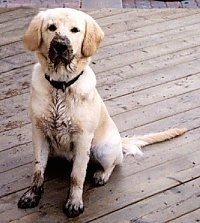
This little mud lover is named Bailey, a Golden Retriever puppy at 6 months oldSay you have a 6 month old pup – if we do the 7 to 1 rule math, your pup would be the equivalent of a three and a half year old child.  Anyone who has spent time with a rambunctious pup and a 3 year old toddler can probably readily see the similarities!  The pup is aching to be a big dog – exploring its entire world with its nose and new teeth – itching to try out its newly found coordination and strength.  

Likewise, the toddler is walking, talking and mastering her independence with that shudder-inducing phrase, “NO!”

Both the pup and the toddler are exploring new levels of independence and confidence.  And we look at them both and know they are far from the ‘finished’ adult products they each think they are.

Fast forward to the 2 year old dog.  Compared to our human toddler, he’s maturing exponentially faster.  Using our 7 to 1 rule, our dog is now 14 in human years – a young teenager.  

And again, anyone watching the painfully awkward stages of a human teenager can often suddenly relate to the same social ineptitude and struggles of a 2 year old dog – if they stop to think about.

To read more about ‘The Terrible Two’s’ for dogs, check out our earlier blog post:  "The Terrible Twos"

Now let’s move forward in time again.  Our canine friend has just hit 4 years old.  Using our 7 to 1 rule, our dog is (finally) officially an adult; probably around 28 years old. 

At this age, he’s established where he belongs in his family.  His social circles are pretty well defined and fixed He has set social circles of intimate friends and family; and while he can still make new friends, he takes a bit longer to warm up to strangers.  He may be less tolerant of new dogs or people who are socially inept and get in his space.  Like most humans of the equivalent age, he’s begun to be somewhat more selective about who he hangs out with.  


This is all assuming our 4 year old dog has had mostly positive experiences throughout his social development.  Dogs, just like humans, carry memories of traumatic (or even just annoying) interactions with them through their lives.  Imagine a 28 year old human who had less than ideal childhood, teenage, and young adult experiences.  That 28 year old human may be less socially developed than another human with different, more positive life experiences.

How about a 6 year old dog?  If our 7 to 1 rule holds, this dog is now around 42 human years – a fully mature adult, who most likely still feels quite spritely and ready for life, but who is even more set in behavior patterns and routines.  Even more than our 4 year old dog, this dog has a very clear idea of who he wants to be friends with, and who he doesn’t. 

So often, I have clients with dogs between the ages of 5 and 8 or so who are surprised their dogs are not itching to meet and play with every single dog they see.  Owners are caught off guard when their mature dog snaps or growls at a puppy who has just jumped on its shoulders. 

This adult Rottie is hardly amused with the younger, smaller dog's antics.
But again – if we think about the emotional and behavioral age of the 5 to 8 year old dog (35 to 56 human years), I think we’d be hard pressed to find many humans in that age range who are fans of having toddlers or teenagers jump all over them exuberantly and inappropriately. 

Even worse, imagine going to a party for people your own age, and suddenly being surrounded by adults who are not acting their age, but are behaving like toddlers or teenagers.  This is generally disconcerting to even the easiest-going of folks, be they dogs or humans.


Of course, as we fast forward to the ‘golden years’, our dogs continue on the fast track of the 7 to 1 rule.  The 10 year old dog is emotionally equivalent to a human at age 70. The 12 year old dog is a sage 84, and so on.

Often, it’s only as our dogs age that we begin to really pay attention to their changing social, emotional, and behavioral needs.  As hearing and sight begin to fail, arthritis kicks in, and sometimes cognitive function declines, owners are often caught suddenly by how rapidly their canine friend has aged.

It may seem quite sudden, and certainly 7 years of advancement to each year of ours is quite rapid.  But if we pay attention to the 7 to 1 rule throughout our dogs’ lives, we can be much better owners – more in tune with changes in social, emotional, behavioral, and physical changes in our dogs.  

Where your dog is on the 7 to 1 behavioral development scale should play a part in your daily decisions about your dog’s overall health and care – from how much mental and physical exercise your dog needs, to whether or not it’s the right time to add a new puppy, and everything in between.

That's it from this end of the leash.

Jennifer Hime is a dog trainer and behaviorist, the owner of Front Range K9 Academy in Wheat Ridge, CO.  


Monday, May 18, 2015

Proper Canine Socialization - Dogs are like BOOBS.

Now that I've got your attention....Yes.  You read that right.

Dogs are a lot like boobs.

Curious?  Read on.

I know that sounds silly.  But if more owners protected their own dogs like they protect their boobs, and if more people on the street would treat dogs like they treat other people's boobs, I would hear of way fewer issues regarding over-enthusiastic puppy greetings, fear bites, and actual aggression in my job.

Think about it...in fact, I'll help you.  Just insert the word "boobs" in the following statements:

1.  Dogs [boobs] are everywhere, but they are not for overt, sustained, focused, public attention or groping.

2.  Just because dogs [boobs] are around - even if the dogs [boobs] belong to a good friend or acquaintance - there are limits on how much interaction is appropriate with the dogs [boobs]...by both people and other dogs!

3.  Dogs [boobs] come in all shapes and sizes.

4.  Some people really want you to notice their dogs [boobs].

5.  Some people are more reserved about their dogs [boobs].

6.  Sometimes, dogs [boobs] are really brought out on display - at barbecues, parties, or other public places.  In fact, a lot of dogs [boobs] are even purposefully being 'shown off' - so to speak.


When it comes to boobs, we all seem to know without talking about it that it's not appropriate to stare at, talk to, or touch them when we see them out and about.  In fact, we take this so far as to know that even talking about NOT talking about them is socially 'off'.

Yet somehow, many people feel it's completely ok to walk right up and begin staring at, talking to, or touching someone else's dog.  Or to let their dog run right up to say "Hi!"

And many dog owners are also unaware that this is not ok.  For dogs - especially as they mature - unwanted fondling, eye contact, and being prattled at by strangers (be they dogs or humans) is uncomfortable!

If you are a dog [boobs] admirer (and anyone reading this blog probably not only admires, but down right loves dogs of all shapes and sizes), your love of dogs [boobs] does not give you license to ogle, fondle, or babble at someone else's dog [boobs].

And for dog owners - the next time you're out in public (or have guests in your home) with your dog, think about...boobs.  I guarantee, if you protect your dog the way you protect your boobs (or your spouse's boobs), your dog will thank you for it!

For both dogs and boobs, there can (and should be) be such a thing as discreet admiration and appreciation.

Jennifer Hime is a canine behavior consultant and the owner and training director at Front Range K9 Academy in Wheat Ridge, CO. She has been working with dogs professionally for 25 years.  She can be contacted through her website at: www.k9counselor.com


Wednesday, April 29, 2015

More on Leash Aggression & Urban Overload

This is a partially revised entry from August, 2011 - As Front Range K9 Academy begins to kick off our campaign to end Urban Overload, we felt this information deserved a reprint!

Are YOU causing your dog's leash aggression or re-activity?

It's important look at the very obvious similarities between humans and dogs when it comes to proper socialization. 

As our dogs mature, we humans often don't keep up with most natural changes in canine social development.  And we continue to let our dogs 'meet' every dog they encounter, thinking, "He's so social. He looooves dogs."

In essence, we're trapping our dogs into adolescent behavior without allowing them to mature and limit their social contacts as they would in the wild as they grew up. Just because your dog was very social as a puppy doesn't mean that behavior will continue into adulthood.

Some humans and some dogs do stay more social throughout life. But really, think about it:

You're social...but do you looooove every human you meet? Just like dogs, as we age, we begin to shrink our social circles - or at least we have fewer people we want to be 
socially intimate with.

Imagine if I tied you up and placed you on a bench outside the grocery store. Then I let every stranger coming and going from the store come up and touch you. Then, if you got upset when a stranger groped you, I slapped 
you instead of the stranger.

It might seem extreme, but this is the equivalent of most leash-to-leash meetings for dogs.

They can't escape; they can't take things slowly or at their own pace; they feel restrained, so they panic and tell the other dog to get away from them the only way they know how: Growling, snapping, etc.
But when dogs do this, they get punished by their owners!

This only worsens the problem, as your dog has no way out. What you are telling the dog is that any dog can tickle, fondle, sniff or downright dominate, molest, or intimidate them and they just have to take it. 


Would you do the same to your child if they were being bullied?

I know this sounds radical to some...but I'm on a roll, so bear with me. With the warmer weather and a slew of dogs out there, these face-to-face, leash-to-leash meetings are more common than ever. And dogs who are forced into these situations generally become worse and worse, and expand the aggression to even off-leash situations.

To make matters even more complicated, the general public perpetuates the problem by continuing to push the myth of 'all dogs like each other.' 


(I bet we ALL can think of a family member, neighbor, or friend who subscribes to this INCORRECT view of canine socialization.)

So...what to do?

1. 
AVOID leashed greetings. If you are walking your dog and another person walking theirs is pressing for a meeting, politely hold up a hand and cross the street. Or put your dog in a stay behind you and block the other dog's access to yours. Or find any other way out of the situation.

(NOTE - you may have to be downright rude about this with some people. So be it. That stranger & strange dog on the street are just that - strangers. You owe them no loyalty and will spend maybe 30 seconds of your life around them. You will spend the next 10 to 15 years with your dog.)

2. 
Don't be the stranger listed up above in item #1. As your dog ages, it very likely doesn't want to meet the every other dog on the street anymore than you want to shake hands with every single person you encounter at the grocery store!

3. 
Supervise off-leash contacts and limit them to dogs that your dog knows and will have a relationship with. 


(Again - referring to item #1 - beyond the puppy stages, dogs tend to become much more selective of who they WANT a long term relationship with, and how intimate they wish to be with those other dogs...they are pack animals after all...and packs tend to be small.)

4. 
Keep in mind what GOOD leashed dog-to-dog interactions should look like. In essence they should look exactly like you at a grocery store, or other place where you and other humans are tightly packed. 


They should look NEUTRAL. If the other dog is being too hyper, too forward, too dominant, too anything, your dog will NOT be able to maintain control, just as you wouldn't be able to maintain control if someone were doing those things to you in a grocery store. 

If your dog needs more work at being neutral around other dogs (remember to keep good distance between your dog and the strange dog), then it's back to the practice field for TONS of distraction-proofing of your stays. (Shameless plug here - we TEACH these skills specifically in our Level 2 Obedience program!)

5. 
Last but not least, spread the word! Let family, friends, and yes - even strangers - know that you are working on teaching your dog appropriate dog-to-dog manners and that you need their help and respect in not allowing other dogs (or people, for that matter) to fondle, caress, or otherwise molest the dog without your permission!

Yes, I'm on a soapbox here, only because this issue is at pandemic levels in our city!!!! Do your part and promote good dog-to-dog social behavior - your dog will thank you for it.

That's it from this end of the leash.

Jennifer Hime is the head trainer & behaviorist at Front Range K9 Academy in Wheat Ridge, CO. She can be contacted at www.k9counselor.com 

Car Sickness in Puppies & Dogs - there is hope!

  Helping a puppy or dog with car sickness can be a bit tricky, but there are several things you can do to make the experience easier for th...